
Beautiful Plants For Your Interior
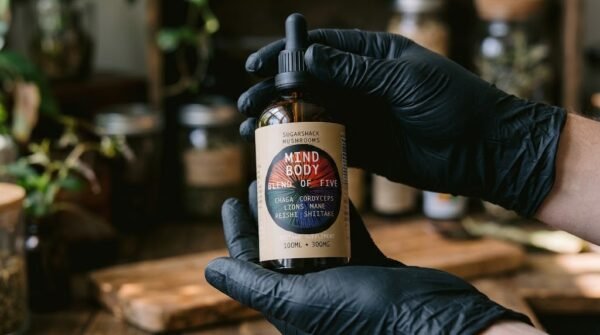
Price range: €85.00 through €350.00
Mushroom tinctures are concentrated liquid extracts made from medicinal or functional mushrooms. They are commonly sold in small bottles with a dropper and may contain extracts from mushrooms such as:
A “mind and body blend” generally refers to a formula combining several mushroom extracts rather than a single species.
The name is primarily a wellness-marketing description, not a standardized medical category.
Manufacturers may formulate these products around complementary goals such as:
Mind-focused ingredients
Body-focused ingredients
The actual ingredients vary considerably between brands, so the product’s ingredient panel matters more than the phrase “mind and body blend.”
Mushrooms contain compounds with different chemical properties. Consequently, manufacturers may use different extraction techniques.
Alcohol can efficiently extract various compounds that are poorly soluble in water.
The mushroom material is soaked in ethanol or another suitable alcohol, after which the extract is filtered and concentrated.
Hot water is commonly used to extract polysaccharides, including beta-glucans.
Some mushroom products therefore use hot-water extraction rather than relying exclusively on alcohol.
Some commercial tinctures use both alcohol and hot water.
The objective is to obtain a broader range of compounds from the mushroom material.
However, “dual extracted” does not automatically mean a product is clinically superior. Quality depends on the mushroom species, extraction conditions, concentration, testing and formulation.
Research into functional mushrooms has focused on several classes of compounds.
Beta-glucans are polysaccharides found in the cell walls of many fungi.
They have attracted substantial scientific interest because of their interactions with immune-related biological pathways.
The amount and structure of beta-glucans can vary substantially between mushroom species and products.
Reishi contains triterpenoid compounds, including compounds commonly referred to as ganoderic acids.
These compounds have been investigated for various biological activities in laboratory research.
Some edible mushrooms contain ergothioneine, an antioxidant-related compound that has attracted interest in nutritional science.
Mushrooms contain numerous additional compounds, including proteins, phenolic compounds, sterols and other metabolites. Their concentrations depend on species, cultivation conditions and processing.
The evidence is species-specific and shouldn’t be generalized from one mushroom to all mushroom tinctures.
For example, lion’s mane has been investigated for neurological and cognitive effects, while reishi has been studied for immune and other biological effects. Much of the evidence comes from laboratory and animal research, while human clinical evidence is generally more limited.
This distinction is important:
A biological effect observed in a laboratory does not necessarily mean that taking a mushroom tincture will produce the same effect in humans.
Likewise, a supplement containing several mushrooms cannot automatically be assumed to provide all the benefits attributed to each individual mushroom.
| Feature | Mushroom tincture | Mushroom powder |
|---|---|---|
| Form | Liquid extract | Dried mushroom material/extract |
| Typical serving | Drops or measured liquid | Powder or capsule |
| Extraction | Often alcohol, water or both | Depends on product |
| Convenience | Easy to measure and carry | Easy to incorporate into foods |
| Ingredient concentration | Highly variable | Highly variable |
| Taste | Can be earthy/bitter | Usually earthy |
| Quality assessment | Requires checking extract details | Requires checking source/extraction details |
Neither format is automatically better. The important factors are what mushroom is used, how it was extracted, how concentrated it is and whether the product has independent quality testing.
If you’re considering a product marketed as a mind-and-body mushroom blend, examine the label carefully.
A reputable label should identify the mushrooms clearly.
For example:
Hericium erinaceus — Lion’s Mane
is more informative than simply saying:
“Proprietary mushroom blend.”
Products can be made from mushroom fruiting bodies, mycelium or a combination.
This distinction should be clearly stated rather than hidden behind vague terminology.
Look for terms such as:
Independent laboratory testing can provide information about:
A certificate of analysis (COA) is more useful when it identifies the actual batch being sold.
Be cautious when a tincture claims to:
Dietary supplements should not be treated as substitutes for established medical treatment.
“Mushroom” does not automatically mean “risk-free.”
Possible issues include:
Some mushroom products may also affect biological pathways relevant to blood clotting, blood pressure, blood glucose or immune activity.
People taking prescription medications should therefore discuss concentrated mushroom extracts with a healthcare professional before using them regularly.
Extra caution is appropriate during pregnancy or breastfeeding, or when someone has a significant medical condition.
A well-documented mushroom tincture should ideally provide:
Clear species identification → transparent ingredient amounts → extraction method → manufacturing information → batch testing → appropriate serving instructions.
A long list of mushrooms isn’t necessarily an indication of a better formula. A simpler product with transparent specifications can be easier to evaluate.
Most functional mushroom tinctures containing lion’s mane, reishi, cordyceps, chaga or turkey tail are not psychedelic.
They are different from preparations containing psychedelic mushrooms such as Psilocybe species.
Some mushrooms, particularly lion’s mane, have been investigated for cognitive and neurological effects. However, research does not establish that commercial mushroom tinctures reliably improve memory in healthy people.
Cordyceps products are frequently marketed for energy and athletic performance. Human evidence is mixed, and effects can depend on the specific extract and population studied.
Generally, no. A mushroom tincture shouldn’t automatically be considered a replacement for a balanced diet or a vitamin/mineral supplement when one is medically indicated.
There isn’t a scientifically established universal timeframe. Effects depend on the mushroom, extract, dose, individual factors and the outcome being measured.
No. Two products labeled “mushroom blend” can contain completely different species, extraction methods and concentrations.
Mind and body mushroom tinctures are concentrated liquid mushroom extracts marketed for broad wellness purposes. Their potential effects depend heavily on the particular mushrooms and extraction methods used. Research is promising for some mushroom-derived compounds, but evidence for many commercial blends remains limited, and marketing claims can extend beyond what human clinical research supports.
| Quantity and Prices | 1 Bottle of 100ml-300mg, 2 Bottles of 100ml-300mg, 4 Bottles of 100ml-300mg, 5 Bottles of 100ml-300mg |
|---|
Reviews
There are no reviews yet.